
GETAHEAD Is Growing Its Metal Forming Tooling Business
GETAHEAD is expanding its die tooling business, building on decades of hands-on experience in tool engineering and manufacturing across our team.
Why are we putting an increasing focus on tooling?
Because we believe mastering tooling in India and Southeast Asia will be one of the key ingredients for building truly diversified industrial supply chains at scale.
Finding alternative suppliers is an important first result.
Having the industrial tooling ready to produce accurate, high-quality components reliably and at hundreds of thousands or millions of parts is what turns a successful supplier search into industrial reality.
Good production tooling is what makes scalability possible
A vehicle like the Tesla Semi is a highly visible finished product. Much less visible are the production technologies behind it that make manufacturing accurate components at high volumes possible. Metal forming tooling is one of them.
India, Vietnam and other China+1 markets combine promising cost structures with rapidly developing industrial capabilities. Over the coming decades, we expect these markets to play a much larger role in high-volume industrial production.
But competitive labor, machinery and available production capacity alone aren’t enough.
The engineering, tooling and industrialization capabilities behind the production process need to develop with them.
That’s exactly where we see an important role for GETAHEAD.
China+1 tooling requires more than finding a lower-cost toolmaker
For many international automotive companies, China has set the benchmark for sourcing tooling from Asia.
This didn’t happen overnight.
Over roughly the past 20 years, Chinese toolmakers have learned to work within highly structured international automotive programs: detailed tooling standards, engineering reviews, defined project milestones, regular reporting, tryout loops, dimensional validation and customer-specific documentation.
Tier 1 press shops and OEM engineering teams have become accustomed to this environment.
India and Southeast Asia now offer highly interesting alternatives. Cost structures can be attractive, industrial capabilities are developing quickly, and a broader Asian supplier footprint can reduce dependence on a single country and diversify tariff and geopolitical exposure.
But we shouldn’t expect to move an RFQ from China to another country and find the same supplier ecosystem waiting for us.
A supplier may have the machinery and technical capability to build a good tool while still requiring substantially more guidance throughout the project.
The cost advantage of ASEAN and India is attractive. Capturing it requires stronger project management, engineering support and presence on the ground. That’s where GETAHEAD comes in.
German engineering know-how, applied in new markets
Our German roots and networks give us access to something that remains highly relevant to this transition: deep engineering know-how in precision stamping, tool & die engineering and structured industrialization.
Germany has been an important technology source for the development of modern stamping and tooling capabilities around the world. German OEMs, Tier 1s, machinery companies and tooling specialists also contributed to the development of many capabilities that international customers rely on in China today.
This know-how can now help develop the next generation of supplier markets.
At GETAHEAD, we combine access to established engineering experience with execution teams on the ground in India and Southeast Asia.
Our working model is deliberately hands-on.
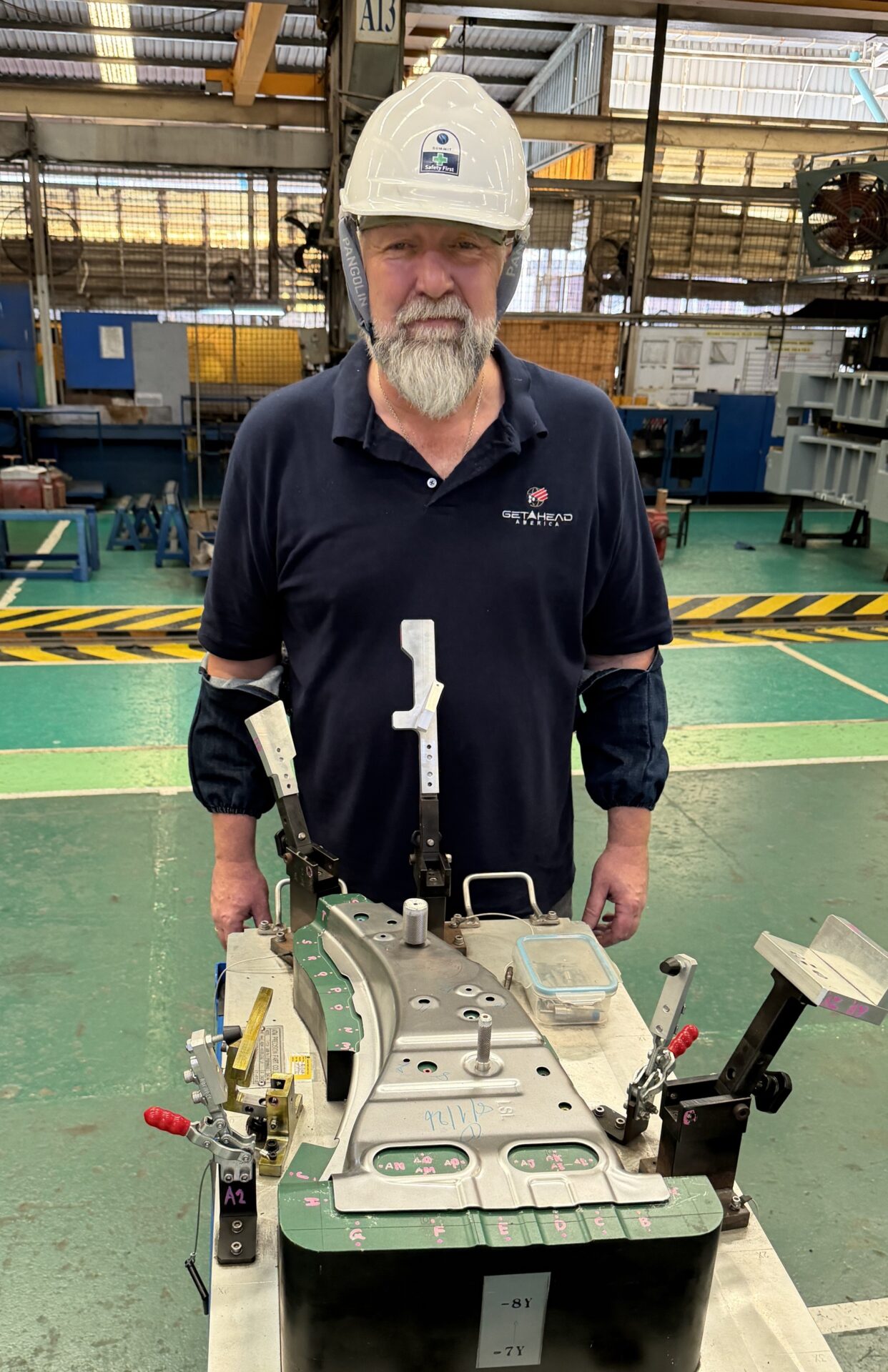
GETAHEAD has successfully worked alongside Tier 1 and OEM Supplier Industrial Engineering (SIE) experts on projects across China+1 markets.
The customer’s engineers bring their product knowledge, production requirements and company-specific standards. Our teams bring local supplier knowledge, engineering understanding and the ability to continuously follow what is actually happening on the ground.
Rather than replacing the customer’s engineering organization, we extend its reach into the supplier market.
Our engineers can be at the supplier throughout the relevant stages, following open points, participating in tryouts, verifying actual progress and working directly with the customer’s experts when technical decisions need to be made.
For us, this is what China+1 means in practice.
Moving an RFQ from China to another country is relatively easy.
Building the local engineering and execution capability around the new supply chain is the harder part.
We don’t just monitor the timeline. We monitor the engineering.
Tooling project management shouldn’t be reduced to asking a supplier whether the project is still on schedule.
The more important questions start much earlier.
Has the supplier developed the right tooling concept for the part?
Before manufacturing release, our engineers review the supplier’s approach against the part requirements, tooling standards, production process and customer expectations.
Technical issues are much cheaper to challenge in the design phase than after steel has been cut.
After design release, the question changes:
Is the supplier actually building what was designed and released?
GETAHEAD follows implementation at the supplier throughout the relevant tooling stages. We monitor manufacturing progress, engineering changes and open points, participate in reviews and tryouts, and follow corrections through closure.
Then comes the final question:
Does the finished tool actually do what it was designed to do?
Tryout results, part quality and process stability ultimately matter more than a project status showing 100%.
This continuous link between part design, tool design, tool build, tryout, correction loops, production run-off, dimensional validation, buy-off and home-line support is a core part of how we manage tooling programs.
Local capability without building another local organization
There is also a simple economic challenge.
A Tier 1 press shop sourcing several tools per year in India may need experienced engineers regularly at its suppliers, but probably not enough to justify building its own permanent engineering organization there.
Another customer may have exactly the same problem.
And so may a manufacturer from a completely different industry buying dies, stampings or other formed metal parts from the same supplier market.
This is where the GETAHEAD model becomes particularly useful.
We pool local engineering, supplier development and project execution capabilities across multiple customers and industries.
Instead of every customer building its own organization in India, Vietnam or another China+1 market, GETAHEAD maintains the local capability and deploys it where individual projects require it.
One project may require a design review. Another may need engineers at a tooling tryout. Another supplier may require a production audit or support closing a quality issue.
The resources are shared. The responsibility for each project isn’t. This gives customers engineering presence on the ground when they need it without having to recreate their China supplier-management organization in every new sourcing country.
Problems should be solved where the tool is built
Tooling projects don’t always go according to plan. Expecting them to do so is usually a bad starting point.
Design questions come up. Tryouts identify issues. Parts need corrections. Timelines change.
The important question is how early these issues become visible.
A problem identified during a design review can still be a relatively easy discussion.
The same problem identified after the tool has been built can become an expensive correction.
Discovering it after the tool has crossed an ocean is considerably worse.
Problems should be solved where the tool is being built – that’s why local presence matters.
Taking the model beyond automotive
Automotive has naturally been an important part of our metal forming work. It combines demanding tooling requirements with mature engineering and supplier quality processes.
But the underlying model isn’t limited to automotive.
Commercial vehicles, industrial equipment, appliances, electrical products and many other industries depend on stamped and formed metal components and face similar challenges when developing new supply chains.
They want access to the promising cost structures and industrial capabilities available in India and Southeast Asia.
But they don’t necessarily want to build another engineering and supplier-management organization in every country they source from.
That’s the gap GETAHEAD is designed to close.
Industrializing new supply chains means more than finding suppliers. It means making them work.
The cost advantage may get you interested in a new supplier market – execution determines whether you can scale it.

 Call
Call 